kmplot
GraphicsKaplan-Meier and competing-risks curves with risk tables

Version 1.0.0 | 2026-10-26



Quick Start · Installation · Options · Gallery · Stata-Tools · Report a bug
kmplot draws Kaplan-Meier survival or cumulative failure curves, or Aalen-Johansen cumulative incidence curves with a competing event, from stset data, with confidence bands, a number-at-risk table, medians, and a log-rank p-value in one command. It returns the risk table, landmark estimates, and plot metadata in r(), and can save the curve data for reuse.
Quick Start
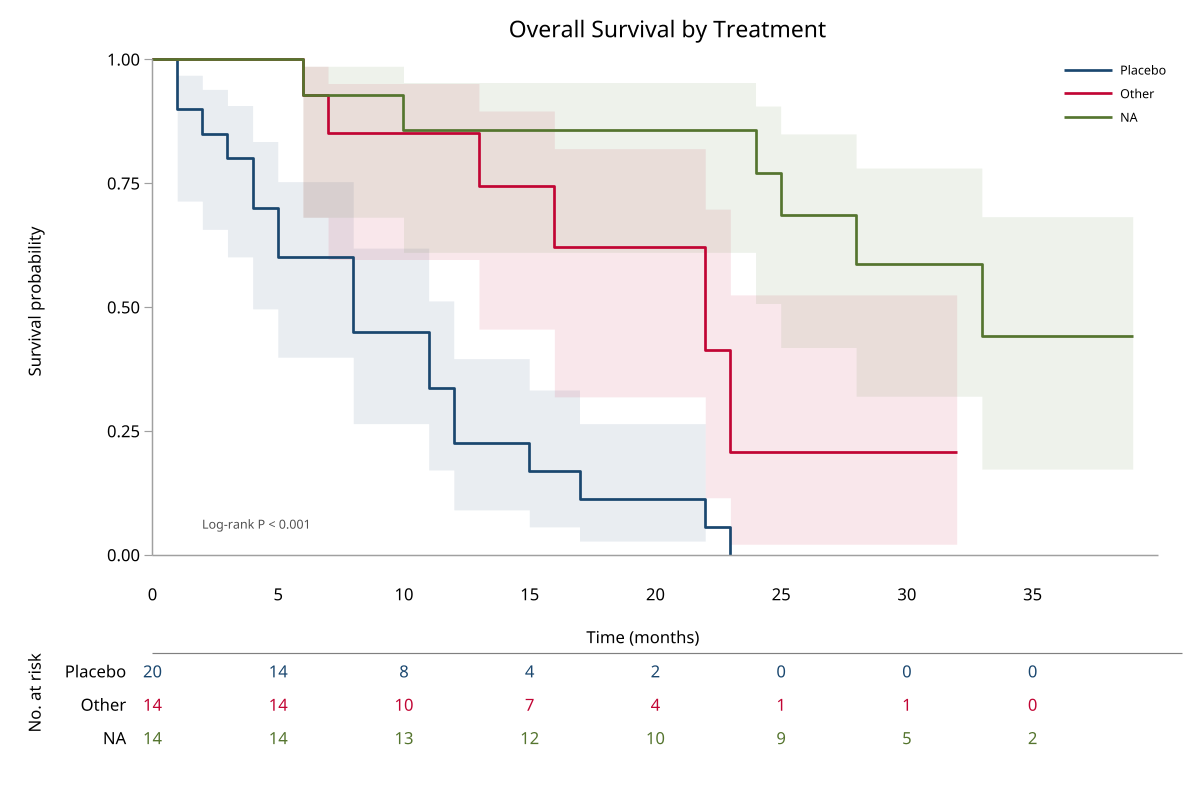
After installing, draw a publication-style figure from Stata's own cancer trial data (the label define line names the two active drugs, which cancer.dta labels "Other" and "NA"):
sysuse cancer, clear
label define type 2 "Drug A" 3 "Drug B", modify
stset studytime, failure(died)
kmplot, by(drug) ci median medianannotate pvalue censor risktable riskevents timepoints(0 5 10 15 20 25 30 35)
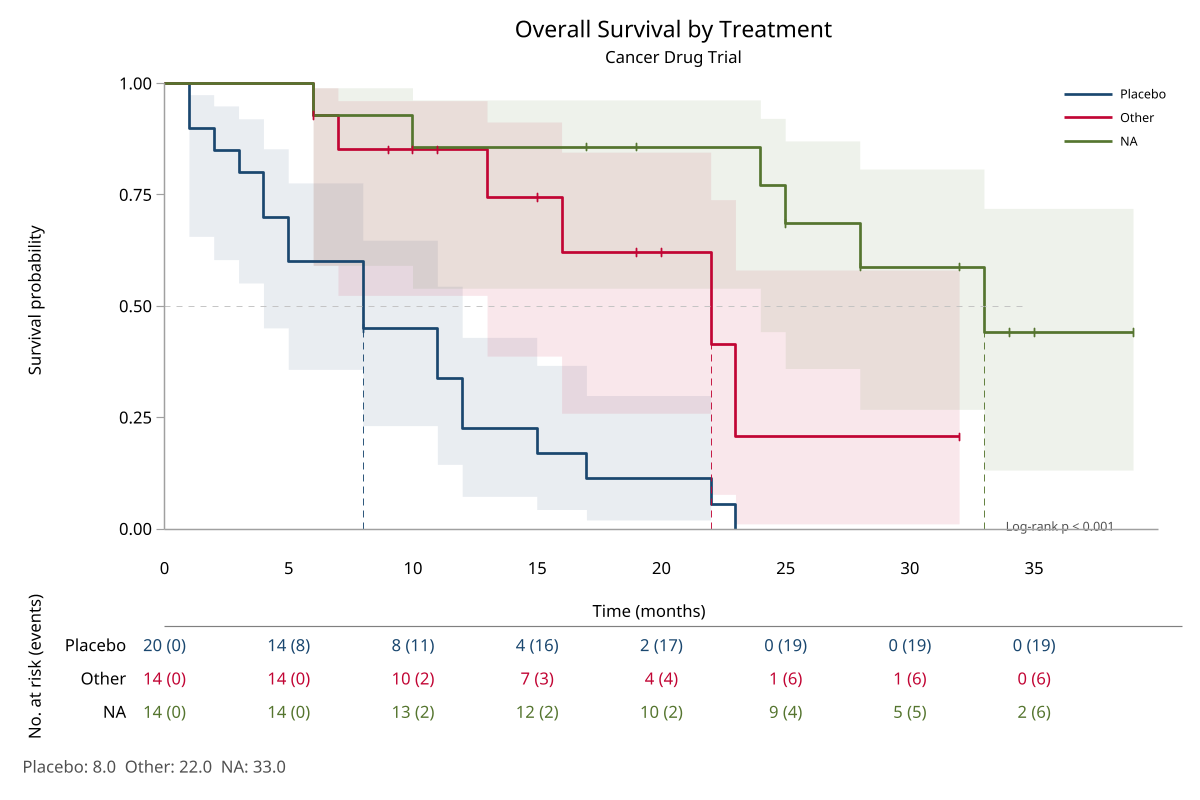
Drawn by demo/demo_kmplot.do, which also sets the white_tableau scheme and adds title(), subtitle(), and xtitle("Time (months)").
Features
- Competing risks.
compete(exp)draws the Aalen-Johansen cumulative incidence, weighted by thestsetweight; without weights its standard errors and ln(-ln) bounds matchstcompet. - Risk tables that line up. The number-at-risk table shares the plot's time axis, and its counts honour delayed entry and multiple-record data. Under probability weights it counts people by default (
riskweight()), andriskmask()prints small counts as<5. - Colour-blind-safe by default. Curves use the Okabe-Ito palette, chosen to stay distinguishable under simulated red-green colour-vision deficiency for up to five groups;
colors()takes Stata colour names or quoted RGB triplets. - The numbers behind the picture.
median,landmark(), andpvalueadd median lines, fixed-time estimates, and the log-rank p-value, and store them inr(medians),r(landmarks), andr(p). - Follows
stsconventions. Greenwood standard errors with log-log (default), log, or plain intervals; bounds are missing where the estimate is exactly 1 or 0, as insts list. - Reusable output.
saving()andrisksaving()write the curve and risk-table datasets;export()writes the graph to PDF, PNG, EPS, or SVG.
Requirements
- Stata 16 or later
- Data declared with
stset - No external packages
Installation
capture ado uninstall kmplot
net install kmplot, from("https://raw.githubusercontent.com/tpcopeland/Stata-Tools/main/kmplot") replace
Commands
| Command | Description |
|---|---|
kmplot |
Draw Kaplan-Meier survival or cumulative failure curves with publication-oriented defaults |
How It Works
kmplot reads the current stset definition and plots a step-function Kaplan-Meier estimate for the analysis sample; no separate model-fitting command is required.
- The default graph is survival,
S(t). Addfailureto plot cumulative failure,1 - S(t). - Add
by(varname)for one curve per group; numeric and string grouping variables are supported, and value labels are used when available (unlabelled numeric levels show asvarname=valuein the variable's display format). - Add
cifor confidence intervals. The default is a shaded log-log interval;cistyle(line)draws dashed interval lines, andcitransform(log)orcitransform(plain)changes the transformation. - Add
risktablefor a number-at-risk table,landmark()for fixed-time estimates,medianfor median reference lines, andcensorfor censoring marks. Risk tables place the time axis above a separating rule, use larger default text, count subjects in multiple-record data, and honor activestsetweights. - Add
compete(exp)to plot the cumulative incidence of thestsetfailure with the records whereexpis true as a competing event (Aalen-Johansen; a competing event leaves the risk set instead of being censored). percent,ymax(),tmax(), andbyorder()set a percent axis, the axis limit, the plotted horizon, and the group order; failure and incidence plots get an automatic y range that fits the curves.- Add
pvaluewithby()when at least two groups are present to display the Stata log-rank p-value; invalid p-value requests exit with return code 198. saving()andrisksaving()write reusable curve and risk-table datasets, whileexport()writes the graph through Stata'sgraph export.- Standard
twowaygraph options are passed through after the namedkmplotoptions.
Choosing a Workflow
| Goal | Starting point |
|---|---|
| One overall survival curve | kmplot |
| Curves by treatment or another group | kmplot, by(group) |
| Manuscript-style comparison | kmplot, by(group) ci risktable median pvalue censor |
| Cumulative failure display | Add failure to the stratified workflow |
| Competing event (e.g. death) present | kmplot, by(group) compete(cause == 2) risktable after stset ..., failure(cause == 1) |
| Weighted cohort figure for a journal | Add riskmask(5) percent tmax(#); counts stay unweighted under pweights |
| Fixed-time reporting or reproducible data export | Add landmark(), saving(), or risksaving() |
Worked Examples
1. Basic Kaplan-Meier curve
The default is a single survival curve with step-function rendering.
sysuse cancer, clear
stset studytime, failure(died)
kmplot
2. Stratified publication-style figure
This combines confidence bands, a risk table, median reference lines, censoring marks, and a log-rank p-value for the treatment groups.
sysuse cancer, clear
stset studytime, failure(died)
kmplot, by(drug) ci risktable median medianannotate pvalue censor
3. Cumulative failure with selected risk-table times
Use failure for 1 - S(t) and specify the risk-table columns explicitly with timepoints().
sysuse cancer, clear
stset studytime, failure(died)
kmplot, by(drug) failure risktable timepoints(0 5 10 15 20 25 30 35)
4. Fixed-time estimates and saved datasets
landmark() returns estimates at the requested analysis times; the two saving options create datasets that can be reused in a table or downstream figure.
sysuse cancer, clear
stset studytime, failure(died)
kmplot, by(drug) ci risktable landmark(12 24) saving(km_curve.dta, replace) risksaving(km_risk.dta, replace)
matrix list r(landmarks)
matrix list r(risktable)
5. Custom confidence intervals, styling, and export
The graph can use line confidence intervals, a different transform, custom colors and patterns, a repositioned p-value, and a directly exported PDF.
sysuse cancer, clear
stset studytime, failure(died)
kmplot, by(drug) ci cistyle(line) citransform(log) colors(navy maroon dkorange) lpattern(solid dash dot) pvalue pvaluepos(bottomleft) export(km_figure.pdf, replace)
Gallery
Run demo/demo_kmplot.do from a repository checkout to regenerate the PNGs below from sysuse cancer and, for the registry-scale panel and the landmark output, from the synthetic cohort in the repository's _data/; the two competing-risk panels use self-harm as the event, death as the competing event, and stabilized inverse-probability-of-treatment weights. The images are repository documentation assets and are not part of the net install payload.
| Output | Command focus |
|---|---|
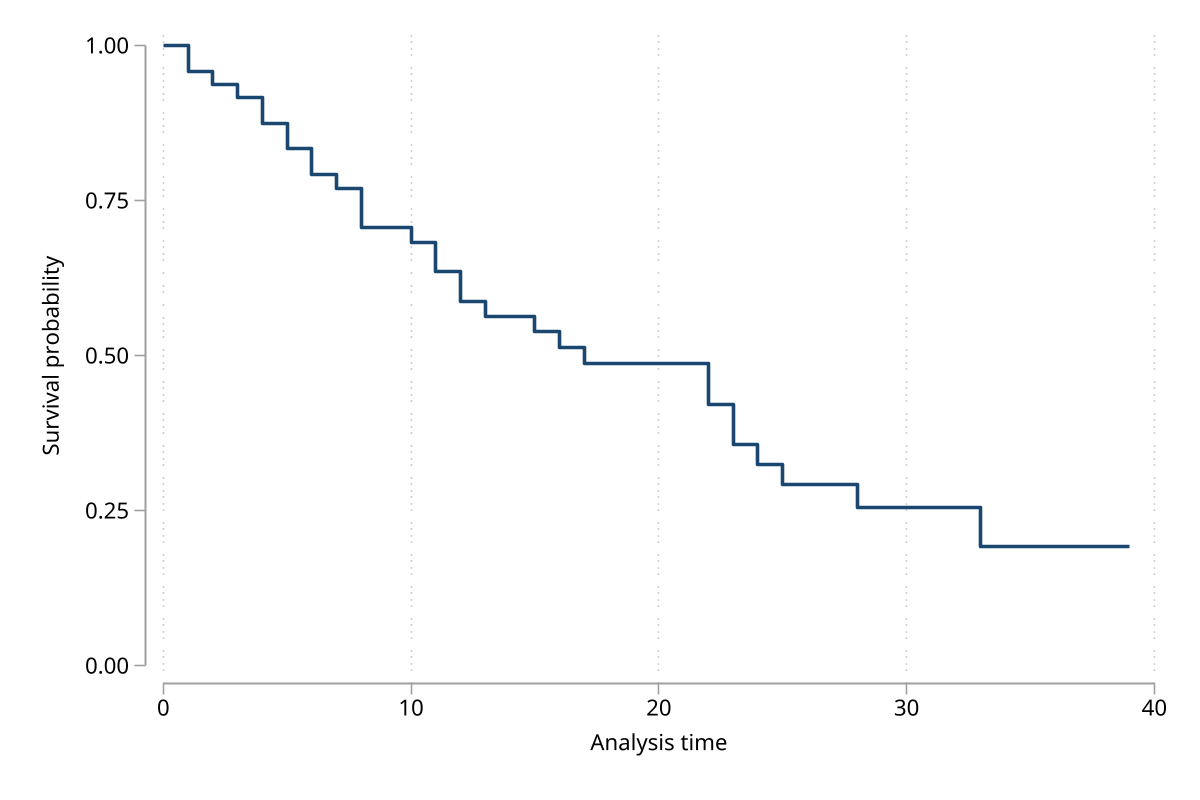 |
Basic kmplot workflow |
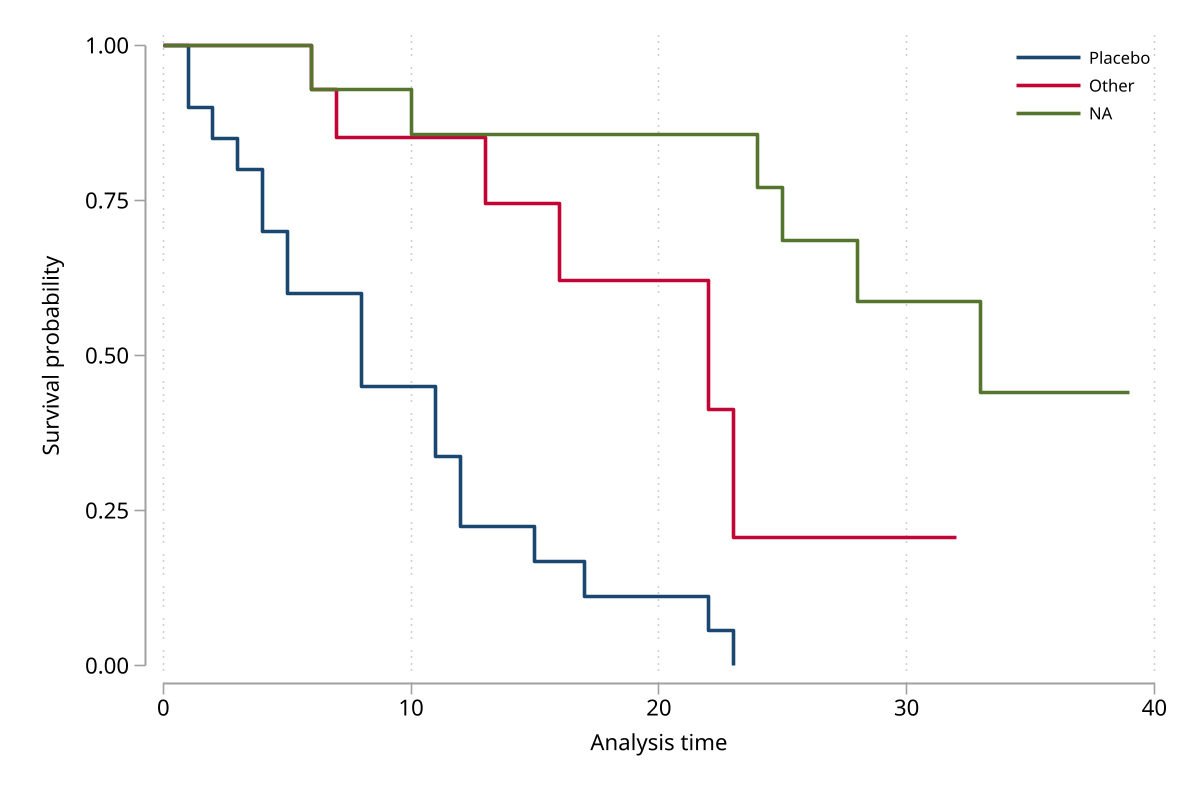 |
by() |
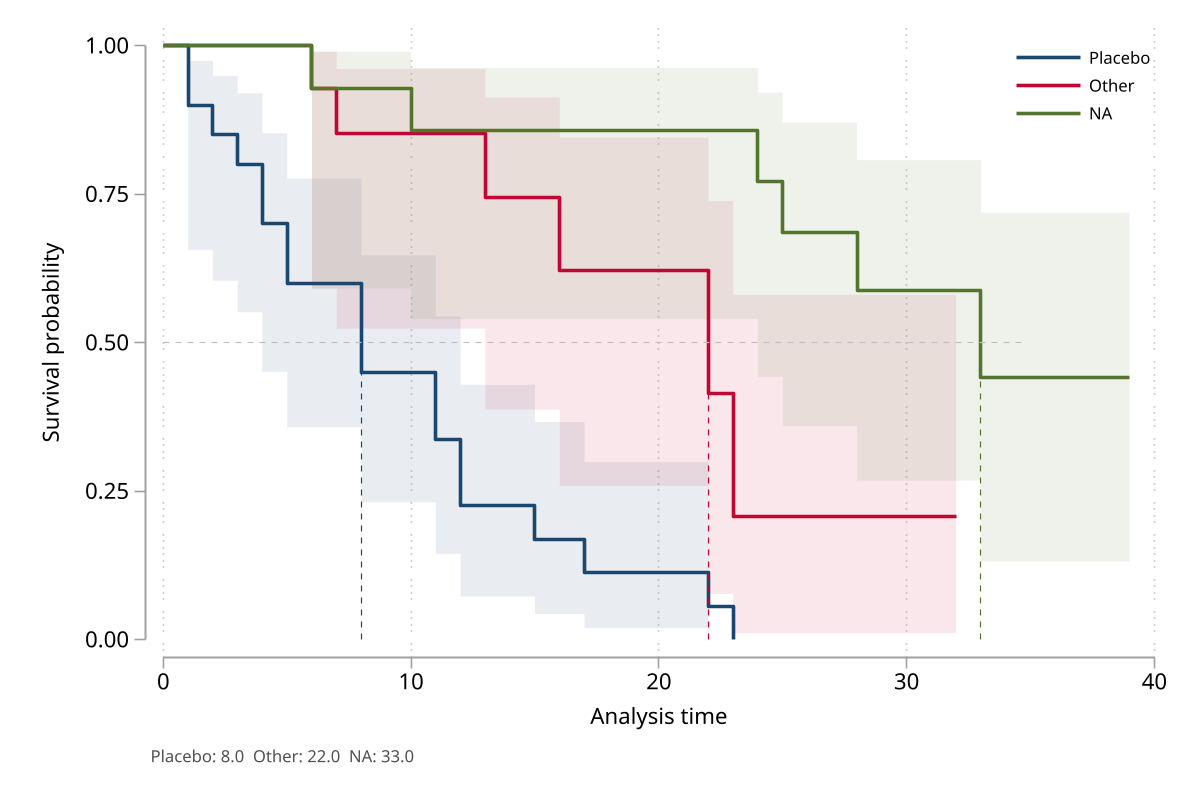 |
ci, median, and medianannotate |
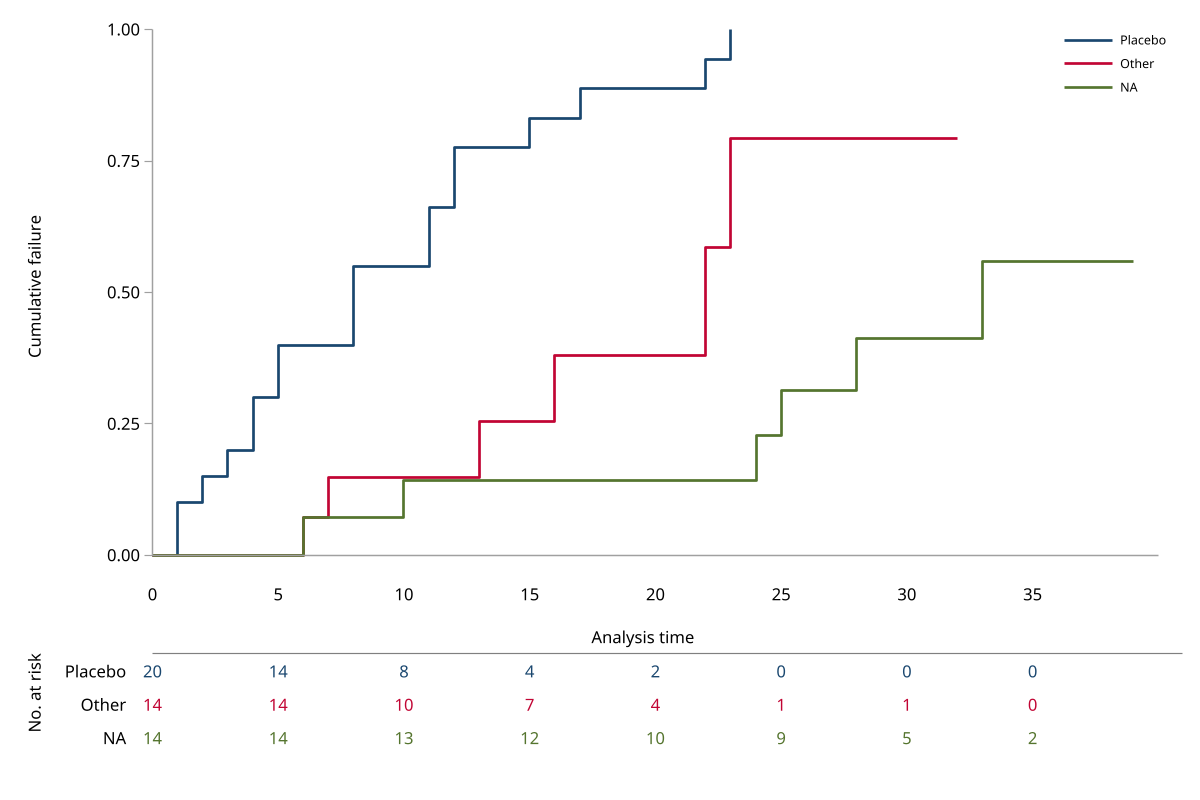 |
failure, risktable, and timepoints() |
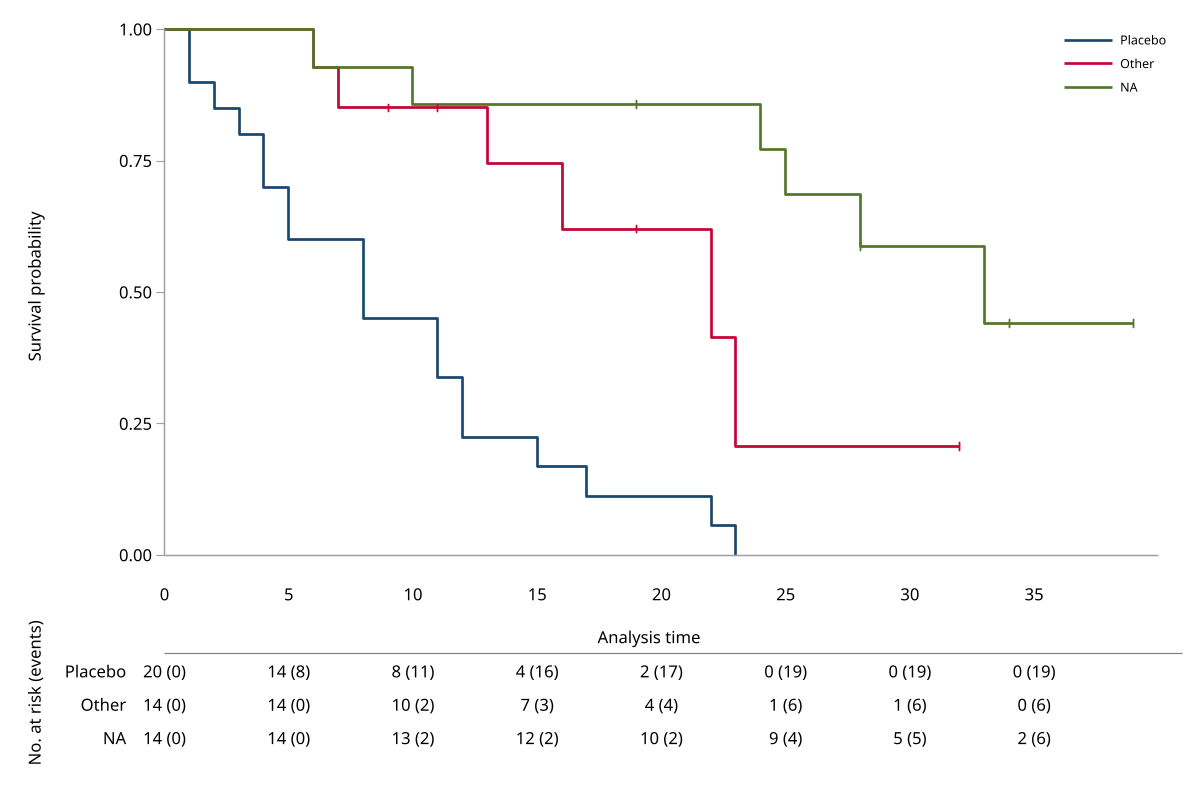 |
riskevents, riskmono, and censor |
|
Combined manuscript workflow |
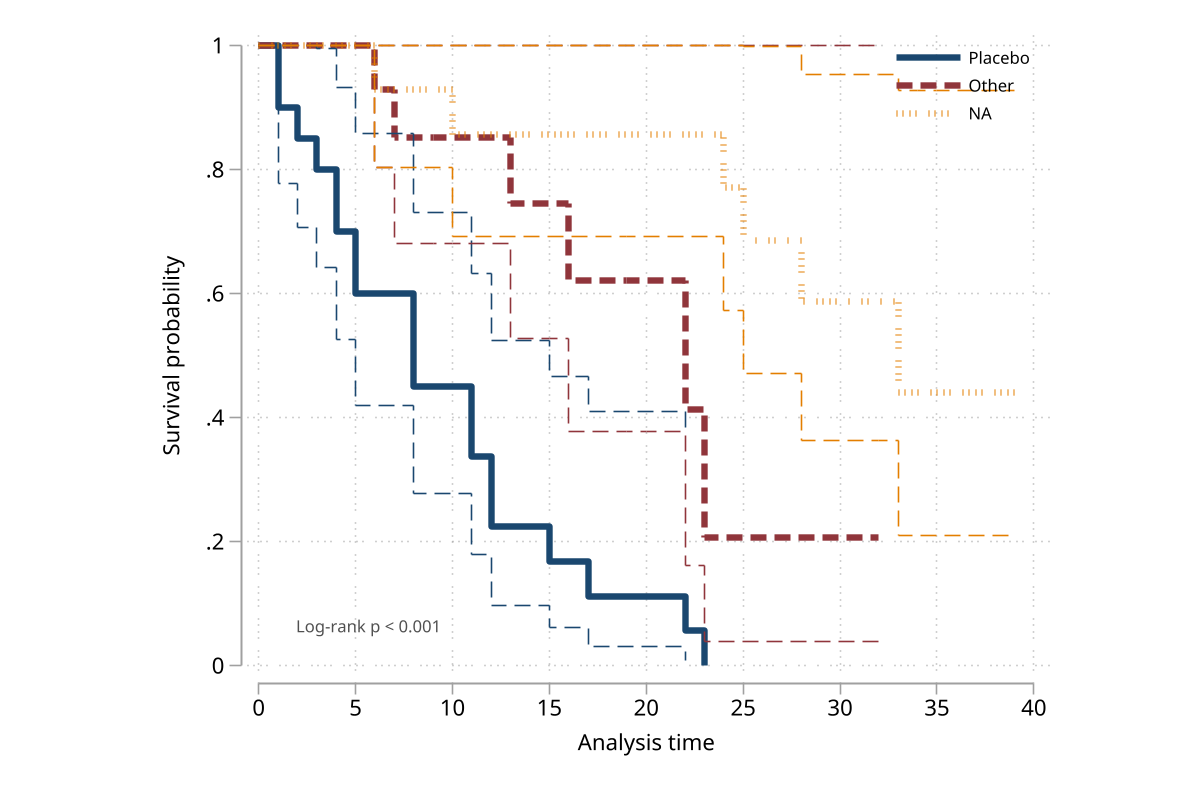 |
cistyle(line), colors(), lpattern(), and pvaluepos() |
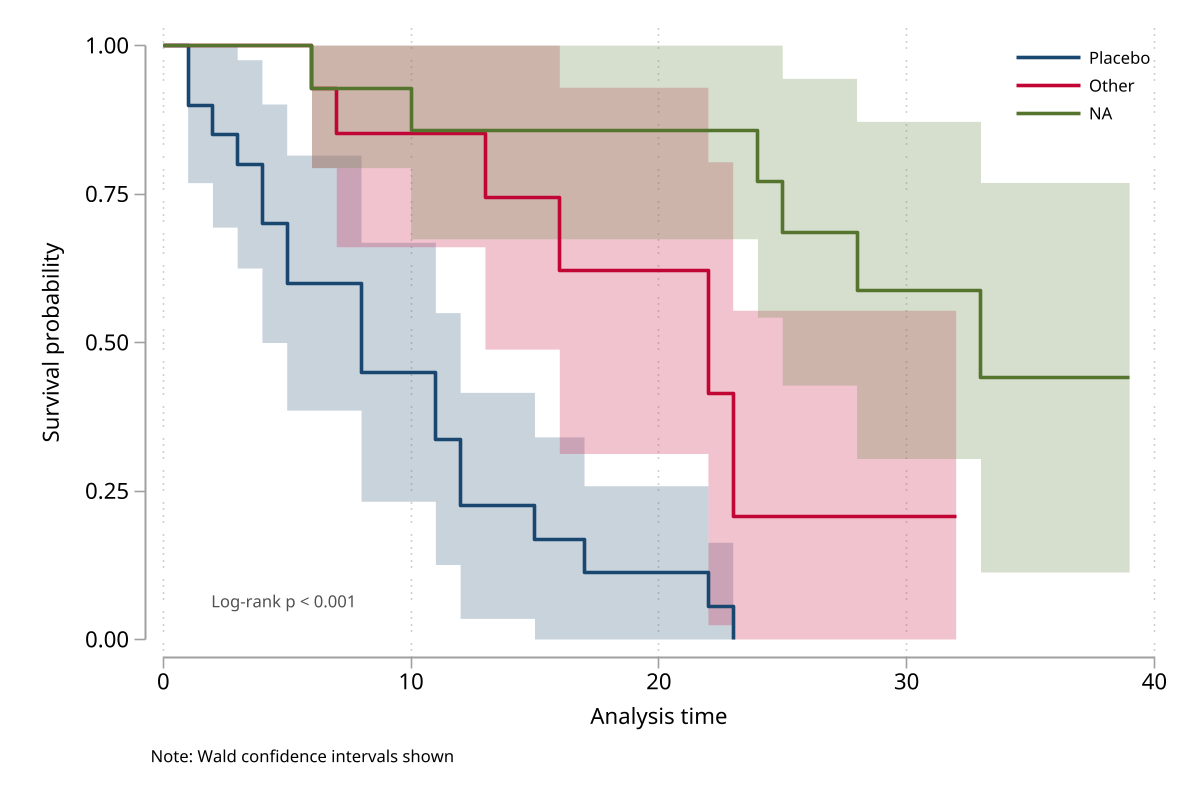 |
citransform(plain), ciopacity(), and note() |
 |
level(90), pvaluetext(), and pvalueformat() |
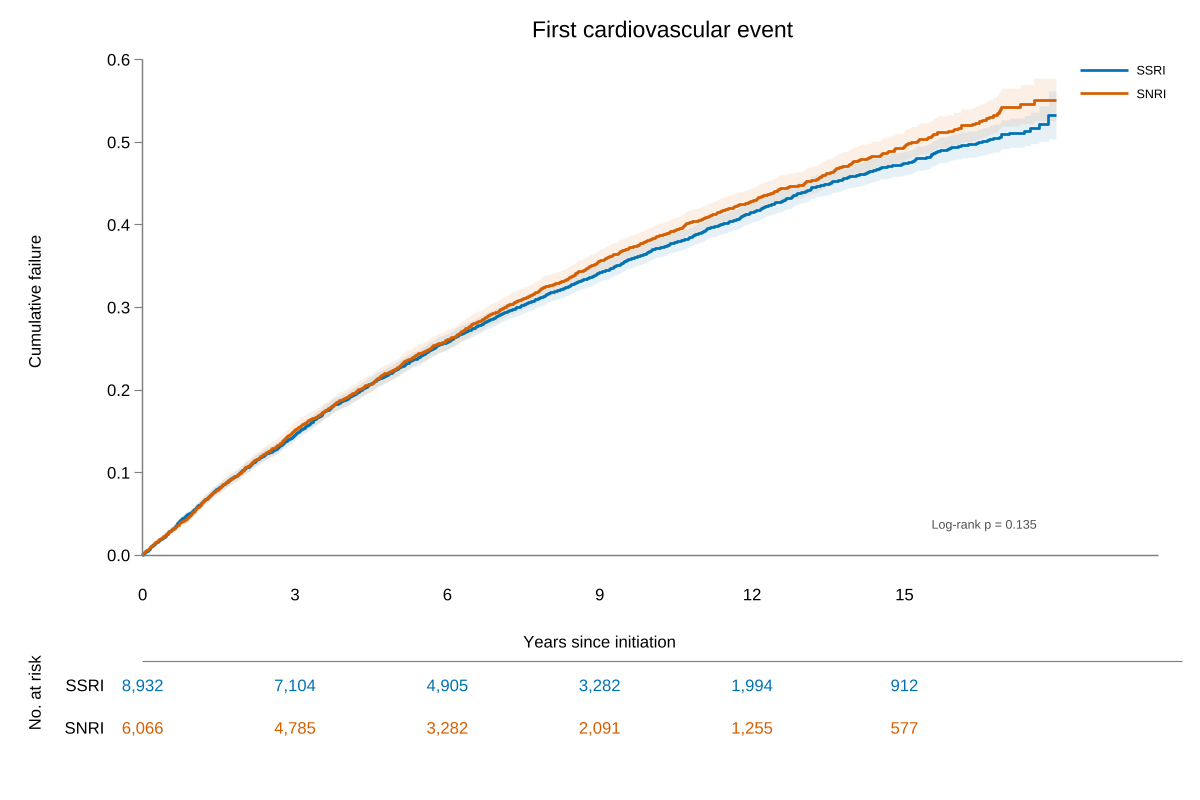 |
Registry-scale failure with risktable; p-value in its default position |
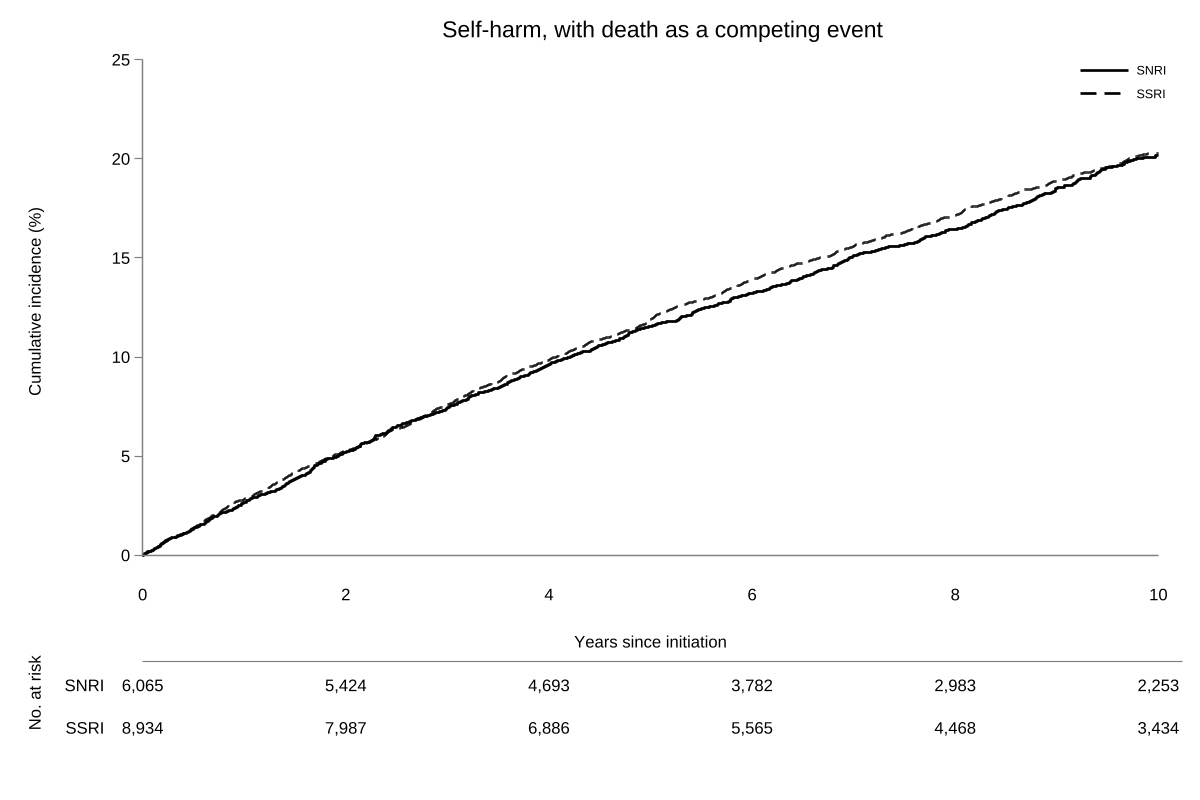 |
compete() under pweights with percent, tmax(), byorder(), and people counts in the risk table |
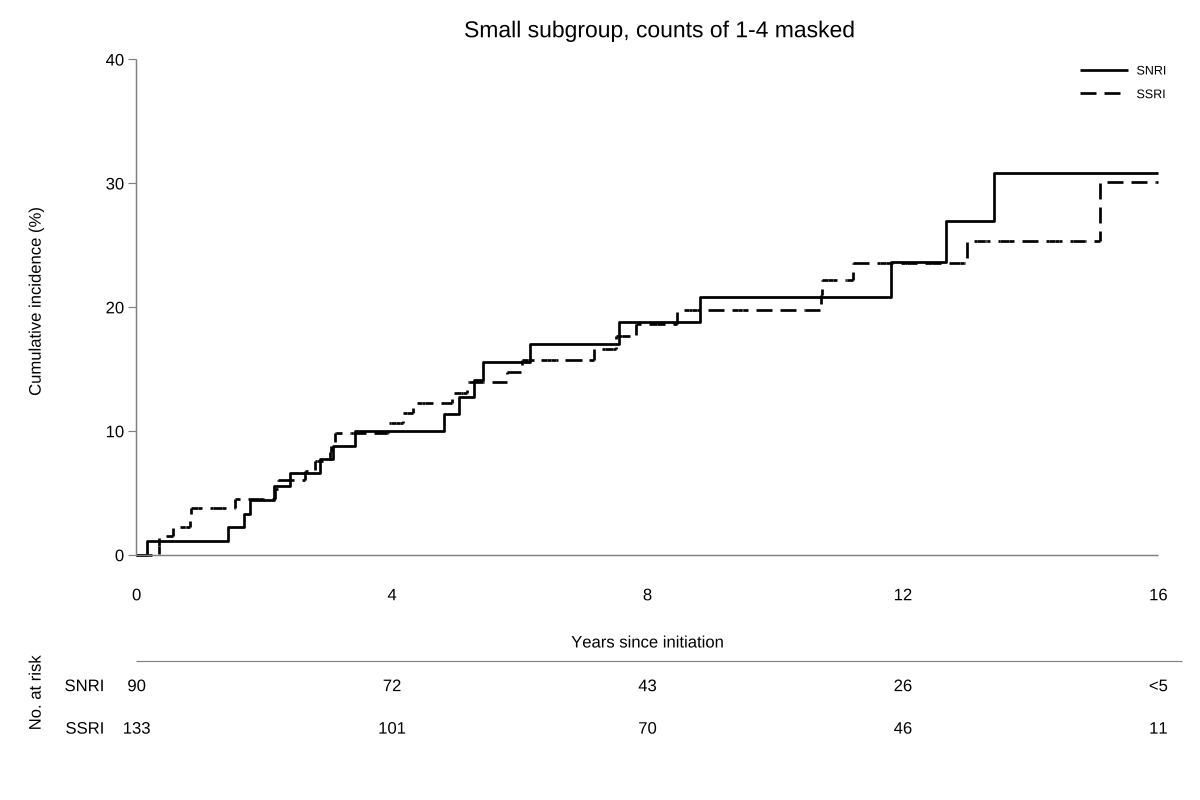 |
riskmask(5) small-count masking |
Landmark output from the demo
landmark() returns the estimate at fixed analysis times in r(landmarks), with bounds when ci is specified. Rows are indexed by group in the order of r(group_labels). From the same synthetic cohort:
kmplot, by(treated) failure ci landmark(1 5 10)
matrix list r(landmarks), format(%7.4f)
Groups: SSRI | SNRI

r(landmarks)[6,5]
       group      time  estimate     lower     upper
r1    1.0000    1.0000    0.0536    0.0491    0.0585
r2    1.0000    5.0000    0.2243    0.2154    0.2335
r3    1.0000   10.0000    0.3678    0.3564    0.3795
r4    2.0000    1.0000    0.0517    0.0463    0.0576
r5    2.0000    5.0000    0.2258    0.2150    0.2370
r6    2.0000   10.0000    0.3816    0.3675    0.3961
Competing-risk output from the demo
With compete(), landmark() returns the Aalen-Johansen cumulative incidence and r(estimator) names the estimator. The weighted run has no bounds because ci is refused under pweights. On the same weighted cohort, 1 - Kaplan-Meier, which treats deaths as censored, gives a higher 10-year risk:
kmplot, by(treated) byorder(1 0) compete(status == 2) landmark(1 5 10) nodraw
matrix list r(landmarks), format(%7.4f)
kmplot, by(treated) byorder(1 0) failure landmark(10) nodraw
matrix list r(landmarks), format(%7.4f)
Estimator: aalen_johansen   Groups: SNRI | SSRI

r(landmarks)[6,5]
       group      time  estimate     lower     upper
r1    1.0000    1.0000    0.0265         .         .
r2    1.0000    5.0000    0.1153         .         .
r3    1.0000   10.0000    0.2018         .         .
r4    2.0000    1.0000    0.0282         .         .
r5    2.0000    5.0000    0.1188         .         .
r6    2.0000   10.0000    0.2030         .         .

Estimator: km_failure

r(landmarks)[2,5]
       group      time  estimate     lower     upper
r1    1.0000   10.0000    0.2154         .         .
r2    2.0000   10.0000    0.2164         .         .
6. Competing risks with a weighted cohort
Cumulative incidence of pelvic recurrence with distant recurrence as the competing event in Stata's cervical-cancer hypoxia data, weighted by illustrative stabilized inverse-probability weights for pelvic-node status. The plot is on a percent axis stopped at 8 years, the risk table counts women (counts of 1-4 masked), and the figure is black and white under the sj scheme.
webuse hypoxia, clear
logit pelnode age hgb tumsize
predict double ps, pr
summarize pelnode, meanonly
generate double sw = cond(pelnode, r(mean) / ps, (1 - r(mean)) / (1 - ps))
stset dftime [pw=sw], failure(failtype == 1)
kmplot, by(pelnode) byorder(1 0) compete(failtype == 2) risktable riskmask(5) percent tmax(8) timepoints(0(2)8) colors(black black) lpattern(solid dash) landmark(5) scheme(sj) graphregion(color(white))
matrix list r(landmarks)
Options
| Option | Default | Effect |
|---|---|---|
by(varname) |
none | Stratify curves by a numeric or string variable |
failure |
survival | Plot cumulative failure, 1 - S(t), instead of survival |
compete(exp) |
none | Plot the Aalen-Johansen cumulative incidence of the stset failure with exp (a single expression) marking the competing event; implies failure; not with pvalue or median; ci without weights or with fweights only; a note is shown when exp is true on no record |
byorder(numlist) |
sort order | Order of numeric by() levels for drawing, legend, colors, patterns, and risk-table rows |
ci |
off | Draw confidence intervals |
level(#) |
c(level) (95 unless changed by set level) |
Set the confidence level for ci; values must lie between 10 and 99.99 with at most two decimal places |
cistyle(string) |
band |
Use shaded bands or dashed line intervals; requires ci |
ciopacity(#) |
12 | Set shaded-band opacity from 0 to 100; requires ci with band intervals |
citransform(string) |
loglog |
Use loglog, log, or plain confidence intervals; requires ci |
median |
off | Draw median reference lines for groups whose median is reached |
medianannotate |
off | Add median values to the graph note; requires median |
medianformat(%fmt) |
%9.0g |
Numeric (%f, %g, %e) display format for medians in the graph note and console summary; requires median |
risktable |
off | Add a separated number-at-risk table below the graph, with the time axis above it |
riskevents |
off | Add cumulative events as N (events) in the risk table; requires risktable |
riskcompact |
off | Synonym for riskevents; requires risktable |
riskmono |
off | Display risk-table numbers in black instead of line colors; requires risktable |
riskheight(#) |
auto | Set risk-table height; requires risktable; supplied values must be greater than 0 and no more than 80 |
timepoints(numlist) |
auto | Set risk-table timepoints, sorted with repeats dropped (0(0.1)1 equals the typed decimals); none may exceed tmax(); requires risktable or risksaving() |
riskweight(none|stset) |
none (pweight, iweight), stset (fweight) |
Count people or sum the stset weight in the risk table; requires risktable or risksaving() |
riskmask(# [, text(string)]) |
off, or tabtools set smallcells |
Print counts from 1 to #-1 as <#; masked cells are missing in r(risktable) and risksaving() |
noriskmask |
off | Ignore the tabtools session small-cell default |
landmark(numlist) |
none | Return survival or cumulative-failure estimates at fixed nonnegative analysis times, sorted with repeats dropped |
censor |
off | Show censoring marks on the curves |
censorthin(#) |
1 | Show every Nth censor mark; requires censor and a value of at least 1 |
pvalue |
off | Display the log-rank p-value; requires by() |
pvaluepos(string) |
bottomright |
Place the p-value at bottomright, topright, topleft, or bottomleft, anchored 5% inside the drawn y range |
pvalueformat(string) |
%5.3f |
Set the numeric (%f, %g, %e) display format for the p-value; p-values below 0.001 are shown as < 0.001 whatever the format |
pvaluetext(string) |
Log-rank p |
Set the text printed before the p-value |
pvalueat(y x) |
none | Place the p-value at explicit graph coordinates; may not be combined with pvaluepos() |
colors(colorlist) |
Okabe-Ito palette | Set curve colors as Stata color names or quoted RGB triplets; the default is blue, vermilion, black, sky blue, reddish purple, orange, and bluish green, which stay distinguishable under simulated red-green color-vision deficiency for up to five groups |
lwidth(string) |
medthick |
Set curve line width |
lpattern(patternlist) |
solid |
Set curve line patterns |
title(string) |
none | Set the graph title; this and the four options below take text [, textbox options], with several quoted strings for several lines and a size() that replaces the default |
subtitle(string) |
none | Set the graph subtitle |
xtitle(string) |
Analysis time |
Set the x-axis title; xtitle("") draws none, also with risktable |
ytitle(string) |
mode-dependent | Set the y-axis title; the default is Survival probability, Cumulative failure, or Cumulative incidence (with (%) under percent) |
xlabel(string) |
automatic | Set x-axis labels; their numeric positions (labelled lists such as 0 "Start" 12 24 included) set risk-table columns when timepoints() is omitted, and with risktable an xlabel() without numeric positions (#5, minmax, none) then needs timepoints() |
ylabel(string) |
automatic | Set y-axis labels; survival uses 0(0.25)1, failure and incidence plots run from 0 to just above the plotted maximum; text labels are supported |
ymax(#) |
automatic | Upper y-axis limit on the plotted scale; refused (rc 198) below the plotted maximum |
percent |
off | Plot 100 × the estimate; r() and saved data stay in proportions |
tmax(#) |
last time | Stop curves, x axis, and default risk-table timepoints at #; estimates unchanged; risk-table times beyond # are refused and median lines beyond it are not drawn |
legend(string) |
automatic | Supply a custom legend specification |
note(string) |
none | Add a graph note; if medianannotate is also requested, the user note replaces the automatic median annotation |
scheme(string) |
current Stata scheme | Set the graph scheme |
name(name[, replace]) |
kmplot |
Set the graph name (a single valid name); a graph of that name is always replaced |
aspectratio(string) |
none | Set the graph aspect ratio |
export(string) |
none | Export to a file; the format is inferred from .pdf, .png, .eps, or .svg, and graph-export suboptions are passed through |
saving(filename[, replace]) |
none | Save curve data with group, group_label, time, estimate, se, lower, upper, censor, and anchor variables: one row per analysis record (tied times repeat) plus one time-zero anchor per group; lower and upper need ci; se, lower, and upper are missing where the survival estimate is 1 or 0 |
risksaving(filename[, replace]) |
none | Save risk-table data with group, group_label, time, at_risk, events, and cumulative censoring exits in censored (on the riskweight() basis), their summed-weight companions at_risk_w, events_w, censored_w, and with masking the flags at_risk_masked, events_masked, censored_masked |
combineopts(string) |
none | Options for the graph combine that joins plot and risk table; requires risktable |
kmplot also accepts standard twoway graph options through its trailing pass-through syntax. With risktable, graphregion(), plotregion(), xsize(), and ysize() also reach the combined graph.
Stored Results
kmplot is an rclass command and stores the following results after it computes a plot. If a requested graph or dataset write fails after plotting, analytical results remain available even though the command returns an error; r(export) records an attempted export path, while r(saving) and r(risksaving) are stored only after successful dataset saves.
Scalars
| Result | Meaning |
|---|---|
r(N) |
Number of observations in the analysis sample |
r(n_groups) |
Number of plotted groups |
r(level) |
Confidence level that applies to ci (stored even when ci is not requested) |
r(failure) |
1 if failure was requested, otherwise 0 |
r(ci) |
1 if ci was requested, otherwise 0 |
r(n_landmarks) |
Number of requested landmark timepoints |
r(n_timepoints) |
Number of risk-table timepoints, or 0 when neither risktable nor risksaving() was used |
r(riskheight) |
Risk-table height when risktable is specified |
r(p) |
Log-rank p-value when pvalue was used with by() and at least two groups were present |
r(pvalue_y) |
Y coordinate of the drawn p-value text when the log-rank p-value was computed |
r(pvalue_x) |
X coordinate of the drawn p-value text when the log-rank p-value was computed |
r(median_#) |
Median for group # (r(median_1), r(median_2), ...), stored with median for groups whose median is reached |
r(ymax) |
Upper y-axis limit on the plotted scale |
r(tmax) |
tmax() when specified |
r(riskmask) |
Masking threshold when masking is on |
Macros
| Result | Meaning |
|---|---|
r(cmd) |
kmplot |
r(graph_name) |
Graph name |
r(plot_type) |
survival or failure (also failure with compete()) |
r(estimator) |
km, km_failure, or aalen_johansen |
r(compete) |
The compete() expression when specified |
r(scale) |
proportion or percent |
r(riskweight) |
none or stset when a risk table or risksaving() was produced |
r(scheme) |
Graph scheme used |
r(by) |
Grouping-variable name when by() was specified |
r(cistyle) |
CI style used |
r(citransform) |
CI transformation used |
r(colors) |
Color list used |
r(lpattern) |
Line-pattern list supplied, if any |
r(timepoints) |
Risk-table timepoints used |
r(landmark_times) |
Landmark timepoints requested |
r(group_labels) |
Group labels joined by a vertical bar |
r(xtitle) |
X-axis title |
r(ytitle) |
Y-axis title |
r(export) |
Requested export path when export() was specified, including after a failed file write |
r(saving) |
Curve dataset path when saving() succeeded |
r(risksaving) |
Risk-table dataset path when risksaving() succeeded |
r(pvalue_text) |
Displayed p-value text when the log-rank p-value was computed |
r(pvalue_label) |
P-value label text when the log-rank p-value was computed |
r(pvalue_format) |
P-value numeric format when the log-rank p-value was computed |
r(pvalue_pos) |
P-value position keyword when the log-rank p-value was computed |
r(pvalue_at) |
Explicit p-value coordinates when supplied; otherwise empty when the log-rank p-value was computed |
r(pvalue_placement) |
Placement of the p-value text relative to its anchor (c with pvalueat()) when the log-rank p-value was computed |
Matrices
| Result | Columns |
|---|---|
r(medians) |
Group and median for each group when median was requested |
r(landmarks) |
Group, time, estimate, lower, and upper when landmark() was requested; bounds are populated when ci is requested |
r(risktable) |
Group, time, at-risk, events, and censored as displayed (masked cells missing) when risktable or risksaving() was used |
Assumptions and Limits
- Run
stsetbeforekmplot; the command uses the current survival-time definition and analysis sample. failureis the complement of the Kaplan-Meier survival estimate,1 - S(t), which treats competing events as censoring; usecompete()for the Aalen-Johansen cumulative incidence. Fine-Gray or covariate-adjusted curves are not implemented.compete()uses the Marubini-Valsecchi variance and ln(-ln) bounds ofstcompet; these are refused under probability and importance weights, and Gray's test is not implemented, sopvalueis refused withcompete().stset exit()must be of the formexit(time exp)withcompete().tabtools set smallcells #(globalTABTOOLS_set_smallcells) sets the defaultriskmask()threshold for every risk table orrisksaving();riskmask()overrides it andnoriskmaskturns it off for one call.nodrawbuilds the graph without displaying it (withrisktable, the combined graph) and still producesr()and saved files; it cannot be combined withexport(), sincegraph exportneeds a drawn graph.riskmask()masks risk-table cells only (graph table,r(risktable),risksaving()); sample totals such asr(N)and the console count of competing-event records are not masked, and the curve's step sizes and censoring ticks can still reveal small counts.riskmask()masks cells, not differences: adjacent at-risk counts and the events between them can still reveal a small censored count by subtraction.- Confidence intervals use Greenwood standard errors with the selected
level()andcitransform();loglogis the default, withlogandplainalternatives. Bounds are reported only where 0 < S(t) < 1: where the estimate is exactly 1 (before the first event, including the time-zero anchor) or exactly 0, they are missing under every transform, as insts list, so shaded bands begin at the first event. Where a curve steps to 0 (1 withfailure), the drawn band or CI lines carry the last bounds to that time, assts graph, cidoes; the returned and saved bounds stay missing there. pvalueuses Stata's log-rank test and requiresby()with at least two groups in the analysis sample.- If a group's survival curve does not reach 0.5,
mediandraws no line for that group and its median entry is missing inr(medians). - Risk-table counts honor delayed entry,
stsetweights as chosen byriskweight(), and subject identifiers. In multiple-record data, each subject is counted once at a timepoint; contiguous records within the same group are not marked as censoring, while departures from a group and terminal censored records are counted incensored. - Landmarks beyond a group's last observed follow-up are missing unless its survival curve has reached zero.
- Probability weights support point estimates;
ciandpvalueare refused, and saved standard errors are missing. The risk table counts people unlessriskweight(stset)is given; fractional weighted counts are then printed to one decimal place, whiler(risktable)andrisksaving()keep the full values. - With importance weights,
ciandpvalueare allowed, as insts, and treat the weights as frequency counts. saving()andrisksaving()support thereplacesuboption only, spelled out as withsave, and must name different files; all three file options are checked before the graph is drawn. The saved files carry no dataset label, notes, characteristics (includingstsetsettings), or value labels from the data in memory.export()passes graph-export suboptions to Stata.- With
compete(), a competing exit lowers the number at risk but is counted as neither an event nor censored in the risk table. - Requested times (
timepoints(),landmark(),tmax()) are compared with_tat the data's precision: with afloattime variable and constantorigin()/scale(),landmark(0.3)includes a death recorded at 0.3 (held as 0.30000001).sts list, at()compares exactly and can differ there.
References
- Aalen OO, Johansen S. “An Empirical Transition Matrix for Non-homogeneous Markov Chains Based on Censored Observations.” Scandinavian Journal of Statistics 5, 141–150 (1978).
- Coviello V, Boggess M. “Cumulative incidence estimation in the presence of competing risks.” Stata Journal 4(2), 103–112 (2004). Source of the variance (Marubini and Valsecchi 1995, eq. 10.12) and ln(-ln) interval (Choudhury 2002) used with
compete(). - Kaplan EL, Meier P. “Nonparametric Estimation from Incomplete Observations.” Journal of the American Statistical Association 53(282), 457–481 (1958). doi:10.1080/01621459.1958.10501452
- StataCorp. Survival Analysis Reference Manual, including
stset,sts generate,sts list, andsts test. - Machado GM, Oliveira MM, Fernandes LAF. “A Physiologically-based Model for Simulation of Color Vision Deficiency.” IEEE Transactions on Visualization and Computer Graphics 15(6), 1291–1298 (2009). doi:10.1109/TVCG.2009.113
- Okabe M, Ito K. “Color Universal Design (CUD): How to make figures and presentations that are friendly to Colorblind people” (2008). jfly.uni-koeln.de/color
QA
QA suites and how to run them are documented in qa/README.md.
Version History
- 1.0.0 (2026-10-20): Initial release. Folded into 1.0.0 before wider distribution:
compete()Aalen-Johansen cumulative incidence (weighted point estimates; unweightedcimatchingstcompet);riskweight()with people counts by default under pweights/iweights;riskmask()small-count masking (with thetabtools set smallcellsdefault); automatic y range for failure and incidence plots,ymax(),percent, and robust textylabel()s;graphregion()/plotregion()/xsize()/ysize()andcombineopts()reach the combined graph;byorder();tmax(); new returnsr(estimator),r(compete),r(scale),r(riskweight),r(riskmask),r(ymax),r(tmax);risksaving()adds*_wand*_maskedvariables;nodrawnow works withrisktable(and is refused withexport()). Review fixes, also folded into 1.0.0: requested times matchfloattime variables, decimal ranges equal the typed decimals, and repeated times are dropped; risk-table times beyondtmax()are refused and median lines stop attmax(); title options take sub-options and several lines;xtitle("")also clears the risk-table title; labelledxlabel()lists set the risk-table columns, and unlabelled-position specifications needtimepoints(); group labels with backticks or dollar signs stay literal;nodrawis matched only as a whole option;name(),pvalueformat(), andcompete()are validated; file options are checked before drawing,saving()andrisksaving()may not share a file, and saved files carry no source metadata;r(ymax)is the decimal axis top.
Author
Timothy P Copeland, Karolinska Institutet
Questions and bug reports: GitHub issues. Please include the first line of which kmplot and your Stata version.
To cite: Copeland TP. kmplot: Kaplan-Meier curves with risk tables. Stata-Tools, https://github.com/tpcopeland/Stata-Tools/tree/main/kmplot. Please give the version you used (which kmplot prints it).
License
MIT (see LICENSE)