tvtools
Time-Varying Data & RegistriesTime-varying exposure data pipeline
Version 1.15.0 | 2026-08-10
tvtools turns person-level follow-up and episode records into analysis-ready time-varying survival data. It gives applied survival analysts transactional builds, composable interval primitives, diagnostics, weighting, fixed-width panels, and exact calendar-timescale splitting.
Quick Start
This complete example creates its own cohort and episode data, so it runs after installation from any working directory.
clear
input long id study_entry study_exit
1 21915 22280
2 21915 22280
end
format study_entry study_exit %td
tempfile cohort episodes
save `cohort'

clear
input long id rx_start rx_stop byte rx_class
1 21919 21965 1
1 22024 22069 2
2 22100 22151 1
end
save `episodes'

use `cohort', clear
tvbuild, sourceusing(`"`episodes'"') id(id) entry(study_entry) exit(study_exit) ///
    start(rx_start) stop(rx_stop) exposure(rx_class) reference(0) ///
    generate(tv_drug) frameout(analysis) replace
frame analysis: tvdiagnose, id(id) start(start) stop(stop) ///
    entry(study_entry) exit(study_exit) all
frame change analysis
generate byte _failure = 0
generate double analysis_t0 = start - 1
stset stop, id(id) failure(_failure) time0(analysis_t0)
tvbuild leaves the person-level master unchanged, commits the interval result in frame analysis, and creates analysis_manifest unless nomanifest is specified. The subtraction of one day maps the package’s closed [start, stop] intervals to Stata’s open-left survival-time convention.
Requirements
- Stata 16 or later.
- No required community package.
- Optional
psdashfortvweight, loveplot; weighting, balance output, andr(balance)do not require it. - Optional
msmfor downstreammsm_prepareandmsm_weightworkflows aftertvpanel.
Installation
Install the released package from Stata-Tools:
capture ado uninstall tvtools
net install tvtools, from("https://raw.githubusercontent.com/tpcopeland/Stata-Tools/main/tvtools") replace
Install optional integrations only when those workflows are needed:
net install psdash, from("https://raw.githubusercontent.com/tpcopeland/Stata-Tools/main/psdash") replace
net install msm, from("https://raw.githubusercontent.com/tpcopeland/Stata-Tools/main/msm") replace
The ancillary menu helper is available with net get tvtools; run do tvtools_menu_setup.do only if you want to add its Stata menu entry.
Commands
| Command | Purpose |
|---|---|
tvtools |
List and categorize the suite |
tvbuild |
Build a committed interval frame from a cohort and one or more sources |
tvspec |
Create and inspect the multi-source specification frame consumed by tvbuild |
tvexpose |
Convert raw episodes or point-time records into time-varying exposure intervals |
tvmerge |
Align two or more interval datasets and combine exposure quantities |
tvevent |
Add single, competing, or recurrent events to interval data |
tvdiagnose |
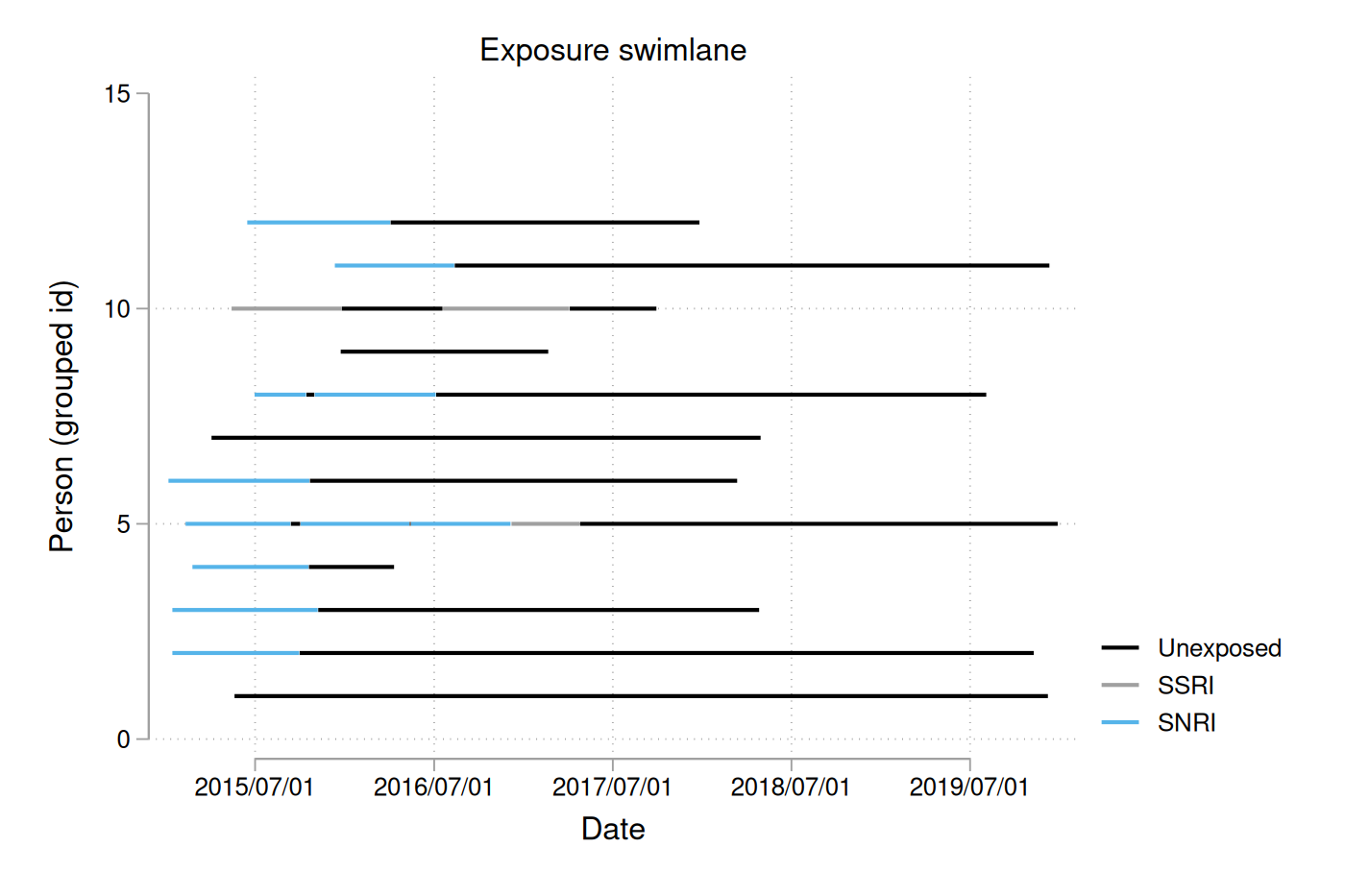
Report coverage, gaps, overlaps, exposure summaries, and swimlanes |
tvweight |
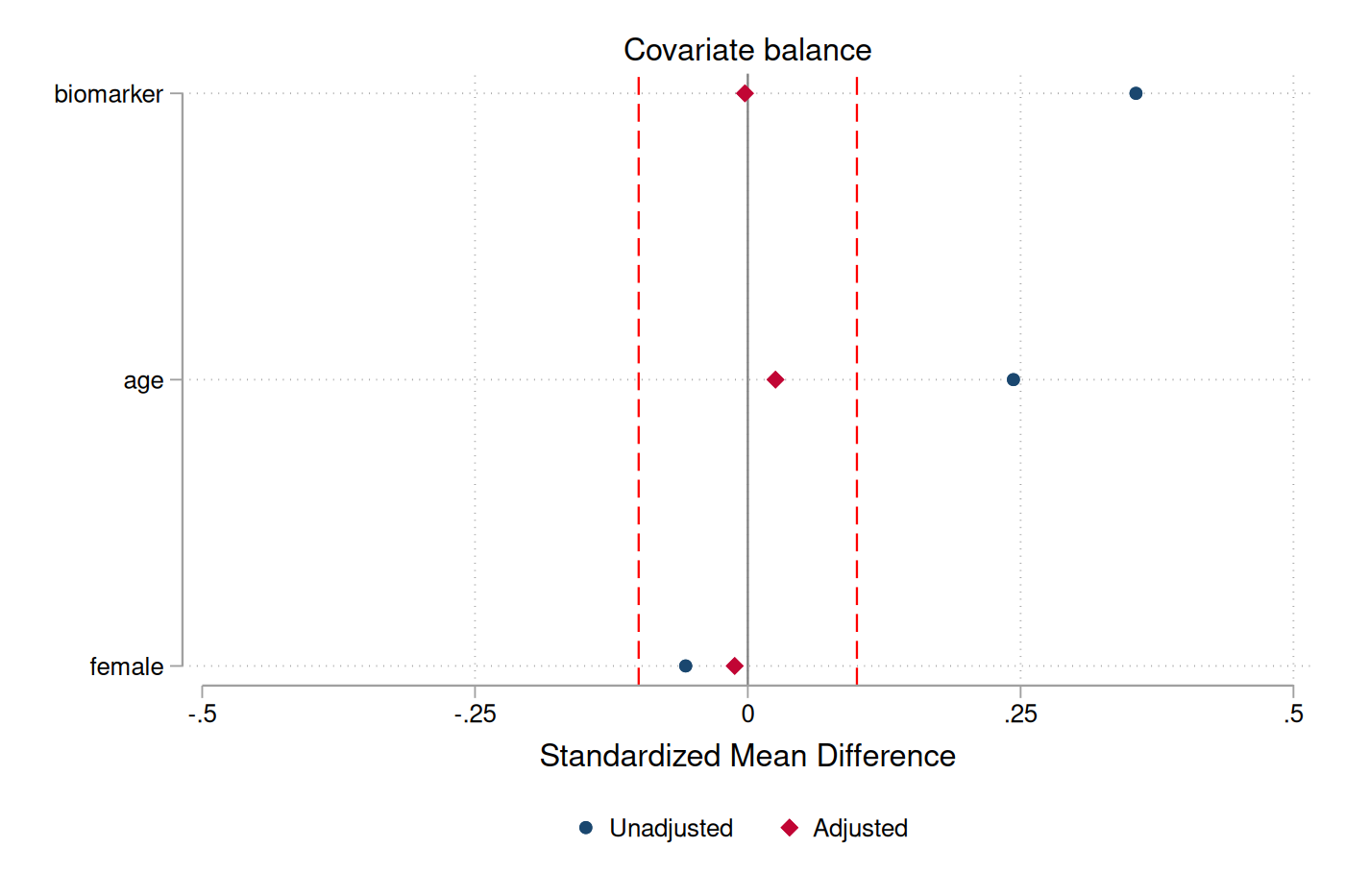
Estimate treatment and censoring weights and report balance and overlap diagnostics |
tvage |
Expand one row per person into exact calendar-age intervals |
tvband |
Split existing intervals on one age, calendar, or elapsed-time axis |
tvsplit |
Split existing intervals on several Lexis timescales at once |
tvpanel |
Build a fixed-width, entry-anchored person-period grid for MSM work |
How It Works
tvbuild is the recommended front door for a cohort plus one or more longitudinal sources: it normalizes a one-source shortcut or a typed tvspec frame, performs a read-only preflight, constructs intervals through the shared engines, optionally integrates events, and commits the destination frame and provenance manifest transactionally.
The primitive workflow is tvexpose → tvmerge → tvevent → tvdiagnose and/or tvweight. Use the primitives when the exposure definition, overlap rule, quantity algebra, or alignment must remain visible as a separate analytical decision.
Every interval in the construction commands is a closed, inclusive interval of integer Stata daily dates, [start, stop]. Abutting rows satisfy next_start = prior_stop + 1; a shared date is an overlap, not an abutment.
tvage, tvband, and tvsplit add exact birthday, calendar, and elapsed-time axes, while tvpanel creates a uniform entry-anchored grid and can carry cumulative exposure history into each period.
Choosing a Workflow
| Need | Use | Result |
|---|---|---|
| One or several sources with a committed, auditable destination | tvspec + tvbuild |
Named output frame, optional manifest, stage counts, and a verified signature |
| An advanced exposure rule or custom interval alignment | tvexpose, tvmerge, and tvevent |
Explicit primitive stages that can be inspected or chained through frames |
| A uniform panel for time-varying treatment models | tvpanel, then tvweight |
Entry-anchored periods, active class, and optional cumulative histories |
| Age, calendar, or follow-up timescale splitting | tvage, tvband, or tvsplit |
Inclusive sub-intervals with exact calendar boundaries |
Worked Examples
The setup block below creates reusable tempfiles for the examples. Run it once in the same Stata session before copying any one of the workflow blocks.
clear
input long id study_entry study_exit byte female
1 21915 22280 1
2 21915 22280 0
3 21930 22280 1
4 21930 22280 0
end
format study_entry study_exit %td
tempfile cohort episodes episodes2 events recurrent
save `cohort'

clear
input long id rx_start rx_stop byte rx_class
1 21919 21965 1
1 22024 22069 2
2 22000 22040 1
3 21950 22030 2
end
save `episodes'

clear
input long id rx_start rx_stop byte rx_class
1 21930 21990 1
2 22050 22100 1
3 21970 22010 1
end
save `episodes2'

clear
input long id event_date death_date
1 22010  .
2     . 22100
3 22020  .
4     .     .
end
save `events'

clear
input long id hosp1 hosp2
1 22010 22100
2 22050     .
3 21980 22030
4     .     .
end
save `recurrent'
1. Plan and commit with tvbuild
dryrun validates the plan and changes nothing; the second call commits the same plan to a named frame and manifest.
use `cohort', clear
tvbuild, sourceusing(`"`episodes'"') id(id) entry(study_entry) exit(study_exit) ///
    start(rx_start) stop(rx_stop) exposure(rx_class) reference(0) ///
    generate(tv_drug) frameout(analysis) dryrun
tvbuild, sourceusing(`"`episodes'"') id(id) entry(study_entry) exit(study_exit) ///
    start(rx_start) stop(rx_stop) exposure(rx_class) reference(0) ///
    generate(tv_drug) frameout(analysis) manifestframe(provenance) replace
frame provenance: list stage source_name n_input n_output, noobs
2. Describe multiple sources with tvspec
tvspec appends one typed row per source and preserves row order; tvbuild applies the cross-source rules and performs the build.
tvspec create build_spec, replace
tvspec add build_spec, name(drug) using(`"`episodes'"') start(rx_start) stop(rx_stop) ///
    exposure(rx_class) generate(tv_drug) reference(0)
tvspec add build_spec, name(second) using(`"`episodes2'"') start(rx_start) stop(rx_stop) ///
    exposure(rx_class) generate(tv_second) reference(0)
tvspec list build_spec
use `cohort', clear
tvbuild, specframe(build_spec) id(id) entry(study_entry) exit(study_exit) ///
    frameout(analysis) manifestframe(provenance) replace
3. Keep a primitive workflow in frames
frameout() leaves the caller’s data intact, and frames() lets tvmerge consume named intermediate results without save/use round trips.
use `cohort', clear
tvexpose using `"`episodes'"', id(id) start(rx_start) stop(rx_stop) ///
    exposure(rx_class) reference(0) entry(study_entry) exit(study_exit) ///
    generate(tv_drug) frameout(f_drug) replace
tvexpose using `"`episodes2'"', id(id) start(rx_start) stop(rx_stop) ///
    exposure(rx_class) reference(0) entry(study_entry) exit(study_exit) ///
    generate(tv_second) frameout(f_second) replace
tvmerge, frames(f_drug f_second) id(id) start(rx_start rx_start) ///
    stop(rx_stop rx_stop) exposure(tv_drug tv_second) frameout(f_merged) replace
use `events', clear
tvevent, frame(f_merged) id(id) date(event_date) compete(death_date) generate(_failure)
4. Track dose history on a regular exposure scale
In dose mode, exposure() is the amount, reference() defaults to zero, and cumulative history is measured at the start of each output row.
clear
input long id study_entry study_exit
1 21915 22280
2 21915 22280
3 21930 22280
end
tempfile dose_cohort dose_episodes
save `dose_cohort'
clear
input long id rx_start rx_stop double dose_mg
1 21920 21950 10
1 21980 22020 20
2 22000 22060 15
3 21960 22030 5
end
save `dose_episodes'
use `dose_cohort', clear
tvexpose using `"`dose_episodes'"', id(id) start(rx_start) stop(rx_stop) ///
    exposure(dose_mg) entry(study_entry) exit(study_exit) dose ///
    generate(cum_dose) keepdates
tvdiagnose, id(id) start(rx_start) stop(rx_stop) exposure(cum_dose) summarize
5. Format recurrent events
For a wide event stub such as hosp1, hosp2, and so on, type(recurring) creates the event-sequence stratum and gaptime adds a reset clock.
use `recurrent', clear
tempfile recurrent_events
save `recurrent_events'
use `cohort', clear
keep id study_entry study_exit
rename study_entry win_start
rename study_exit win_stop
tempfile recurrent_intervals
save `recurrent_intervals'
use `recurrent_events', clear
tvevent using `recurrent_intervals', id(id) date(hosp) type(recurring) ///
    generate(hosp_event) start(win_start) stop(win_stop) enum(stratum) ///
    gaptime gapstart(t0) gapstop(t) timegen(tstop) timeunit(days)
6. Build an MSM panel and estimate weights
tvpanel emits every entry-anchored period, including reference periods, and tvweight can use its period index for a stabilized treatment model.
The synthetic exposure below covers the middle periods for every person, so the all-reference boundary periods are removed before fitting the illustrative treatment model; real analyses should retain only periods with support for the model they specify.
clear
set seed 20260805
set obs 40
generate long id = _n
generate double study_entry = 21915 + floor(runiform() * 20)
generate double study_exit = study_entry + 364
generate double age = 45 + 10 * runiform()
generate byte female = runiform() > .5
generate byte rx_class = runiform() < invlogit(-.4 + .04 * (age - 50) + .4 * female)
tempfile panel_cohort panel_episodes
save `panel_cohort'
keep id study_entry study_exit rx_class
generate double rx_start = study_entry + 40
generate double rx_stop = study_exit - 40
save `panel_episodes'
use `panel_cohort', clear
tvpanel using `"`panel_episodes'"', id(id) entry(study_entry) exit(study_exit) ///
    exposure(rx_class) start(rx_start) stop(rx_stop) width(91) ///
    period(period) generate(tv_class) keepvars(age female) replace
drop if period == 0 | period == 4
tvweight tv_class, covariates(age female) id(id) time(period) ///
    stabilized generate(iptw) nolog
7. Split one interval on several time axes
tvsplit accepts one or more axes and carries the other variables onto every resulting row.
clear
input long id double start stop dob entry
1 21915 22280  -3653 21915
2 21930 22280  1826 21930
end
format start stop dob entry %td
tvsplit, id(id) start(start) stop(stop) ///
    age(dob, width(5) generate(ageband)) ///
    calendar(, width(1) anchor(2020) generate(calband)) ///
    elapsed(entry, width(1) unit(year) generate(fuband))
Demo
Regenerate the checked-in figures and console assets by running demo/demo_tvtools.do from a repository checkout; the demo script creates its own synthetic data and is not part of the net install payload.
local demo_dir "/path/to/checked-out/tvtools/demo"
do "`demo_dir'/demo_tvtools.do" "`demo_dir'"
Command Reference
tvtools
tvtools [, list detail category(string)]
list prints command names, detail prints descriptions, and category() filters to all (the default), prep, diag, or weight. It returns r(commands), r(n_commands), r(version), and r(categories).
Options
| Option | Purpose |
|---|---|
list |
Print command names only |
detail |
Print command names with descriptions |
category(string) |
Select all (default), prep, diag, or weight |
tvspec
tvspec create framename [, replace]
tvspec add framename, name(name) (frame(name) | using(filename)) ///
    start(name) stop(name) exposure(namelist) generate(namelist) ///
    [reference(#) kind(episodes|intervals) referencelabel(string) ///
     label(string) description(string) rate(namelist) total(namelist) ///
     cumulative(namelist)]
tvspec list framename
create writes the empty typed schema; add defaults kind(episodes), requires exactly one of frame() and using(), and maps exposure() to generate() positionally. Episode rows require reference(); interval rows use kind(intervals) and must not specify a reference. rate(), total(), and cumulative() are optional subsets of exposure().
tvbuild
tvbuild, specframe(name) id(varname) entry(varname) exit(varname) frameout(name) [options]
tvbuild, (sourceframe(name) | sourceusing(filename)) id(varname) entry(varname) exit(varname) ///
    start(name) stop(name) exposure(name) reference(#) generate(name) frameout(name) [options]
Options are sourcename(), referencelabel(), label(), startname(), stopname(), dateformat(), keepvars(), dropdates, coverage(), eventframe(), eventusing(), eventdate(), eventtype(), compete(), eventgenerate(), eventlabel(), timegen(), timeunit(), enum(), gaptime, gapstart(), gapstop(), manifestframe(), nomanifest, dryrun, and replace. Defaults include coverage(strict), startname(start), stopname(stop), dateformat(%tdCCYY/NN/DD), eventtype(single), eventgenerate(_failure), timeunit(days), and <frameout>_manifest for the manifest frame.
tvexpose
tvexpose using filename, id(varname) start(varname) exposure(varname) ///
    [reference(#)] entry(varname) exit(varname) [options]
Options are stop(), reference(), generate(), saveas(), frameout(), replace, merge(), evertreated, currentformer, duration(), dose, dosecuts(), continuousunit(), expandunit(), bytype, recency(), recencyunit(), grace(), lag(), washout(), pointtime, fillgaps(), carryforward(), keepvars(), check, gaps, overlaps, summarize, validate, priority(), split, layer, combine(), window(), switching, switchingdetail, statetime, keepdates, referencelabel(), label(), flow, dropinvalid, and verbose. Categorical output is the default; dose defaults reference(0), grace(0), merge(0), lag(0), washout(0), and a derived tv_<exposure> output name.
tvmerge
tvmerge [dataset1 dataset2 ...], id(varname) start(namelist) stop(namelist) exposure(namelist) [options]
tvmerge, frames(namelist) id(varname) start(namelist) stop(namelist) exposure(namelist) [options]
Options are frames(), generate(), prefix(), startname(), stopname(), idname(), dateformat(), saveas(), frameout(), replace, keep(), continuous(), rate(), total(), cumulative(), dropinvalid, batch(), force, check, validatecoverage, validateoverlap, summarize, flow, and verbose. continuous() is the deprecated alias for total().
tvevent
tvevent [using filename], id(varname) date(name) [options]
tvevent, frame(name) id(varname) date(name) [options]
Options are frame(), generate(), type(), keepvars(), continuous(), rate(), total(), cumulative(), timegen(), timeunit(), compete(), eventlabel(), startvar(), stopvar(), start(), stop(), enum(), gaptime, gapstart(), gapstop(), validate, flow, dropinvalid, verbose, and replace. Defaults include type(single), generate(_failure), timeunit(days), start(start), stop(stop), and enum(_enum) for recurring events.
tvdiagnose
tvdiagnose, id(varname) start(varname) stop(varname) [options]
Options are exposure(), entry(), exit(), coverage, gaps, overlaps, summarize, all, swimlane, maxids(), threshold(), and verbose. threshold(30) and maxids(50) are the defaults; coverage requires entry() and exit(), while summarize requires exposure().
tvweight
tvweight exposure [if] [in], covariates(varlist) [options]
Options are generate(), model(), stabilized, wtype(), truncate(), tvcovariates(), id(), time(), replace, denominator(), nolog, balance, loveplot, histogram, estname(), estreplace, cumulative, cumgenerate(), ipcw(), censorcovariates(), censgenerate(), and combgenerate(). Defaults include generate(iptw), model(logit), wtype(iptw), cumgenerate(<weight>_cum), censgenerate(ipcw), and combgenerate(<weight>_ipcw) when those modes are used.
tvage, tvband, tvsplit, and tvpanel
tvage uses id(), dob(), entry(), exit(), generate(), startgen(), stopgen(), groupwidth(), minage(), maxage(), saveas(), replace, and noisily; legacy idvar(), dobvar(), entryvar(), and exitvar() aliases remain accepted. Defaults are age_tv, age_start, age_stop, groupwidth(1), minage(0), and maxage(120).
tvband uses id(), start(), stop(), type(), origin(), width(), min(), max(), unit(), anchor(), generate(), startgen(), stopgen(), saveas(), replace, and noisily. origin() is required for age and elapsed axes and forbidden for calendar; width(1) and elapsed unit(day) are the defaults.
tvsplit uses id(), start(), stop(), age(), calendar(), elapsed(), and noisily; its nested options are width(), min(), max(), anchor(), unit(), and generate(). At least one axis is required, and the default band variables are ageband, calband, and fuband.
tvpanel uses frame(), reference(), width(), start(), stop(), period(), startgen(), stopgen(), generate(), cumulative(), prefix(), keepvars(), saveas(), replace, noisily, dropinvalid, and verbose. Defaults are reference(0), width(91), start(start), stop(stop), period(period), startgen(start), stopgen(stop), and generate(tv_class).
Key Options
Dates, identifiers, and intervals
Use numeric Stata daily dates for interval bounds and event dates; fractional dates, missing required dates, and reversed bounds are rejected unless a command explicitly offers dropinvalid. Most interval commands require the same identifier name and storage type across master and sources, reject strL identifiers, and never silently recast IDs.
The package’s intervals are closed and inclusive, so duration is stop - start + 1. When declaring the result with stset, use time0(start - 1) to map each row to Stata’s open-left convention.
Output and transactions
frameout() stages a result in a named frame and leaves the current data untouched where that option is supported; saveas() writes a file and restores the caller’s data for the commands that document that behavior. replace is required before an existing file or frame is overwritten.
tvbuild requires frameout(), leaves input frames untouched, and builds a manifest named <frameout>_manifest by default; use manifestframe() or nomanifest to control it. dryrun performs the full plan validation without committing destinations.
Quantities and exposure definitions
rate() variables remain rates when intervals are split; total() variables are apportioned by inclusive overlap days; and cumulative() variables are row-start histories carried unchanged. continuous() is a deprecated alias for total() in tvmerge and tvevent.
In tvexpose, categorical output uses reference() for uncovered time, while dose mode defaults the reference to zero. continuousunit() accepts days, weeks, months, quarters, or years; expandunit() defaults to that unit when continuous exposure is requested and uses fixed average widths of 7, 30.4375, 91.3125, or 365.25 days anchored at each episode start.
Stored Results
Result names below are returned in r() after successful execution; option-dependent names are returned only when their option is used.
| Command | Stored results |
|---|---|
tvtools |
Scalar r(n_commands); macros r(commands), r(version), and r(categories) |
tvspec |
Scalars n_sources; macros specframe, source_name for add, and source_names for list |
tvbuild |
Scalars dryrun, spec_version, n_sources, N_persons, event_stage, dates_kept, and committed-run N_periods, n_gap_ids, uncovered_days; macros idvar, entryvar, exitvar, startvar, stopvar, source_names, payload_vars, exposure_vars, rate_vars, total_vars, cumulative_vars, specframe, frameout, coverage, manifestframe, eventvar, timevar, enumvar, gapstartvar, gapstopvar, datasignature; matrices source_counts, stage_counts |
tvexpose |
Scalars for persons, periods, total/exposed/unexposed time, invalid-input counts, window bounds, combined states, and by-type variables; macros genvar, frameout, overlap_ids, recency_unit, recency_cutdays, combine_map, bytype_map; matrix flow when requested |
tvmerge |
Scalars for observations, persons, datasets, quantity counts, invalid rows, gaps, overlaps, and duplicates; macros for datasets, exposure/quantity variables, output names, and destinations; matrix flow when requested |
tvevent |
Scalars N, N_events, quantity counts, invalid-input counts, and event validation counts; macros generate, startvar, stopvar, timegen, enum, gapstart, gapstop, and quantity variables; matrix flow when requested |
tvdiagnose |
Scalars for each requested diagnostic, coverage/gap/overlap summaries, exposure levels, and graph status; macros id, start, stop, graph_name; matrix exposure_summary when summarize runs |
tvweight |
Scalars for sample size, levels, ESS, weight distribution, overlap, positivity, truncation, and graph status; macros for model, weight, output, treatment/censoring, and balance settings; scalar ess_combined and matrix balance in the corresponding modes |
tvage |
Scalars n_persons, n_observations, groupwidth; macros varname, startvar, stopvar |
tvband |
Scalars n_persons, n_observations, width; macros axistype, varname, startvar, stopvar |
tvsplit |
Scalars n_axes, n_persons, n_observations; macros agevar, calvar, fuvar, startvar, stopvar when applicable |
tvpanel |
Scalars for persons, observations, width, and invalid-input counts; macros periodvar, startvar, stopvar, classvar, cumvars |
Assumptions and Limits
- Input dates are numeric, whole-number Stata daily dates; the suite does not interpret Stata datetime values as daily dates.
- Identifiers are structural keys, so source names and storage types must agree and commands never pad, guess, or silently remap them.
tvage,tvband, andtvsplitrequire numeric identifiers; map string IDs deliberately before calling them.tvageintentionally returns only the identifier and generated age interval variables; save or merge covariates separately.tvmergeexpects interval inputs, andforcerestricts mismatched-ID inputs to their intersection rather than inventing missing records.tveventtreats single events as terminal and recurring event stubs as orderedstub1throughstubKmembers; noncanonical or noncontiguous stubs are rejected.tvdiagnosecounts global coverage by interval union, but category summaries can have multi-membership when exposure levels overlap.tvbuildcoordinates construction and provenance but does not runstset, an outcome model, an overlap-resolution choice, or a causal model.- Weighting output is model-based; causal interpretation requires the relevant exchangeability, positivity, treatment-model, and censoring assumptions.
- Longitudinal stabilized weights require the analyst to retain the appropriate past-treatment and baseline history with
tvweight, numcovariates()and, for censoring weights,censnumcovariates(); the outcome model must include the retained numerator terms. tvweight, loveplotrequires optionalpsdash; without it, user(balance)to build a plot with another graphing workflow.
References
- Robins JM, Hernán MA, Brumback B. Marginal structural models and causal inference in epidemiology. Epidemiology. 2000;11(5):550–560.
- Cole SR, Hernán MA. Constructing inverse probability weights for marginal structural models. American Journal of Epidemiology. 2008;168(6):656–664.
- Li F, Morgan KL, Zaslavsky AM. Balancing covariates via propensity score weighting. Journal of the American Statistical Association. 2018;113(521):390–400.
QA
QA suites and how to run them are documented in qa/README.md.
Version History
- 1.15.0 (2026-08-10): Added explicit treatment and censoring numerator models for history-conditioned longitudinal stabilization, exposed both fitted numerator contracts in
r(), corrected the IPCW documentation to match the time-specific default, and removed package-owned paging changes and decorative empty output lines. - 1.14.1 (2026-08-07): Corrected runtime
stsetguidance, verbose table headers, cumulative-weight diagnostics, graph naming, save confirmations, flow notes, event provenance, exported dataset labels, and related console-report polish; added focused regression coverage for each repaired artifact/display path. - 1.14.0 (2026-08-07): Renamed
_dta[tvtools_pipeline*]provenance characteristics to_dta[tvtools_tvbuild*]and cleaned up allpipeline/pipe_*naming throughout documentation, demos, and QA to usetvbuild/workflowconsistently. - 1.13.1 (2026-08-05): Corrected the closed-interval
stsethelp conversion to usetime0(start - 1)so the first follow-up day is retained. - 1.13.0 (2026-08-02): Harmonized console-report layout and corrected display-only leaks and formatting defects without changing estimators, interval semantics, computed values, options, or stored results.
- 1.12.1 (2026-08-02): Hardened provenance-manifest replacement checks and improved diagnostics for damaged specification frames.
- 1.12.0 (2026-08-01): Added
tvspec, madetvbuildprovenance manifests default, and made catalog rendering derive from one command list. - 1.11.0 (2026-07-31): Renamed the released front door from
tvpipetotvbuildand moved its specification and provenance characteristics to the new command name. - 1.10.2 (2026-07-31): Hardened front-door specification validation, recurring-event stub discovery, manifest return normalization, and specification-cell arity checks.
- 1.10.1 (2026-07-30): Repaired
eventlabel()forwarding in the front door and removed duplicate help content. - 1.10.0 (2026-07-30): Added the transactional front door for typed multi-source plans and introduced
tvmerge, idname(). - 1.9.1 (2026-07-30): Made frame-native merging preserve caller frame names and improved cumulative-weight and interval-segmentation internals without changing computed values.
- 1.9.0 (2026-07-25): Corrected panel-mode stabilized weighting, balance-weight selection under IPCW, censoring-indicator validation, and cross-exposure overlap reporting.
- 1.8.0 (2026-07-22): Added collision-safe output planning, explicit overlap composition codes, union-based coverage, date-first event placement, and stricter multiplicity checks.
- 1.7.1 (2026-07-17): Improved interval-overlap performance and deterministic ordering in
tvmerge. - 1.7.0 (2026-07-13): Consolidated interval, quantity, diagnostic, age-anniversary, and output-contract behavior across the suite.
- 1.6.9 (2026-07-10): Added failure-safe output rollback, collision-safe labels, clipped coverage diagnostics, and early identifier validation.
- 1.6.8 (2026-07-03): Corrected opt-in diagnostic paths, short-data error reporting, validation-file naming, and legitimate duplicate-interval handling.
- 1.6.7 (2026-07-02): Added early
strLidentifier rejection and clearer numeric-ID diagnostics. - 1.6.6 (2026-07-02): Corrected exact-width panel endpoints, running-maximum gap logic, output-name collisions, truncation bounds, and estimation-sample IPCW validation.
- 1.6.5 (2026-07-02): Corrected by-type labels and summaries, validation-file collisions, empty-frame output, zero-overlap validation, and non-positional continuous quantities.
- 1.6.4 (2026-07-01): Corrected cumulative products across rows excluded from the estimation sample.
- 1.6.3 (2026-06-30): Consolidated the shared interval engine for panel lookup and event split-point placement.
- 1.6.2 (2026-06-29): Delegated
tvweight, loveplotto optionalpsdashwhile preserving the balance table and matrix. - 1.6.1 (2026-06-29): Added
tvbandandtvsplitto the public package documentation and harmonized help presentation. - 1.6.0 (2026-06-29): Added IPCW and combined weights, positivity diagnostics, and recurrent-event sequence and gap-time formatting.
- 1.5.0 (2026-06-29): Added frame-first output, harmonized aliases, and scriptable output-name returns.
- 1.4.0 (2026-06-29): Added derived output names and collision-safe fallback naming in
tvexpose. - 1.3.0 (2026-06-28): Added single-axis and multi-axis age, calendar, and elapsed-time splitting with exact anniversaries.
- 1.2.0 (2026-06-28): Added Mata interval-overlap and continuous-expansion engines; deprecated
batch()as an ignored compatibility option. - 1.1.0 (2026-06-28): Added balance diagnostics, alternative weight types, cumulative weights, graphing, frame inputs, flow reporting, and swimlanes.
- 1.0.3 (2026-06-26): Hardened panel bookkeeping, value-label handling, and dose-overlap temporary names.
- 1.0.2 (2026-06-19): Standardized public help-file author sections and stored-result presentation.
- 1.0.1 (2026-06-15): Fixed suppressed parser errors, event reshaping bookkeeping, option aliases, and author metadata.
- 1.0.0 (2026-04-08): Initial Stata-Tools release.
Author
Timothy P Copeland, Karolinska Institutet
License
MIT License. See LICENSE.